A Tectonic Novel
Showpiece Dispatch 21
Cover art by artist Marwan Kassab-Bachi, popularly known as Marwan, for an edition of the third volume of Cities of Salt. Good friends, Abdelrahman Munif and Marwan often collaborated together.
December 2, 2025
This past year, I returned to Abdelrahman Munif’s Cities of Salt (Mudun al Milh), at least to the three volumes translated into English. With the two untranslated volumes, the quintet runs to about 2,500 pages, making it arguably the longest Arabic-language novel. Expansive over time and space, the work reveals the insidious consequences of the oil industry on people and landscapes.
Sometimes you remember who recommended a writer to you; other times, the work has so quietly reorganized how you see the world that you can’t recall life before it. For this reason, I had forgotten who introduced me to Munif until my friend Khaled recently reminded me. It makes sense: I once imagined the first volume taking place in Kuwait, where he and I had met.*
As much as Cities of Salt has meant to me, rereading felt like encountering it for the first time. What once struck me as wooden prose now reads as a deliberate strategy. My earlier expectations of character arcs and plot resolution had been disappointed. This time, prepared for Munif’s resistance to such conventions, I appreciated his ingenuity in denying them.
For the English edition, Peter Theroux replaced the first volume’s original title, Al Tih, with the title for the entire work, Cities of Salt. He explained that the layered meaning of al tih, which can be translated as “labyrinth,” “confusion,” or “disorientation,” couldn’t be captured in English. His translation of the second volume, Al Ukhdud, as The Trench flattens some of the meanings, but at least signals the significance of space to Munif: landscapes that sprawl out of sight and plunge down into geology.
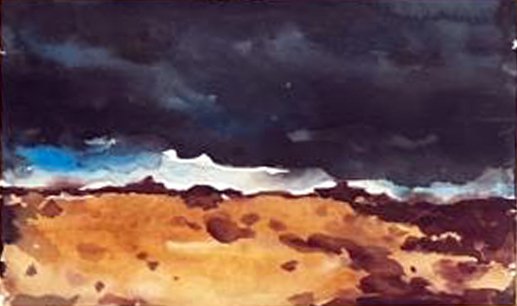
For the cover art from one of the Arabic editions of Cities of Salt, the artist Marwan created stirring landscapes, L–R.
Stirred Landscapes
Many regard Cities of Salt as a foundational example of “petrofiction.” Such categorization might sell it short. I see the volumes capturing a shift, a moment in literature when petroleum became something more than an invisible, unspoken fact of modern life.** The earthen extraction physically shapes the arcs of any fictional character’s life as certainly as it shapes our own. That’s what I love about Munif’s original titles: they signal something tectonic. Like a fault line, petroleum doesn’t actually appear in the work; instead, it haunts.
There’s a cliché act: an article about a Gulf city begins with lines from Cities of Salt, usually the first volume. A go-to excerpt:
With the first light of dawn, huge iron machines began to move. Their deafening noise filled the whole wadi. So gigantic and strange were these iron machines that no one had ever imagined such things existed . . . .
An author might use such a passage to argue that the problem is one of speed. Because of a rush, the argument might go, we are left with “instant cities.” In the first two volumes there are flimsy houses, wannabe palaces, and overheated shops, but I think Munif’s concern wasn’t with haste.
Munif said indeed that “cities of salt” should evoke a wave capable of causing cities to disintegrate. This imagery has been taken to imply a city with a short lifespan, to be swept away in a single gesture. But nearly everything about these novels makes it clear that such an apocalypse will not happen tomorrow. What makes this work “devastating,” as many describe it, is the knowing that everything can disintegrate. Any actual cataclysm would grant a catharsis we’re never allowed.
For another Arabic edition of Cities of Salt, Marwan rendered a face sideways, as a landscape. With each volume, color provides more detail, until we begin to lose the face to saturation. Perhaps Marwan expresses a way of reading Munif’s approach to history: whether with scant or abundant evidence, the past remains a cipher, L–R.
A Novel in Lieu of History
In similar ways, Munif’s five-volume novel also responds critically to Western traditions of the form. Its structure feels brittle, as though barely holding together. Characters, plotlines, even chronology collapse or vanish without warning, but never dramatically. More than once, Munif builds a scene of great expectation: an esteemed figure is due to arrive; the town prepares; there is fanfare. When the person finally appears, the moment dissipates into an epidemic of itchy, town-scale distraction. You never know how much attention to invest in anyone because they can evaporate as you turn the page.
There is a candidate protagonist that one never forgets, Miteb Al Hathal. At first, he seems poised to be the hero of the 2,500-page epic. A champion-in-the-making for the resistance, he rides into desert landscapes beyond our perception. One expects him to return, transformed by arid solitude, either in the flesh or as myth. He doesn’t.
The third volume, Variations of Night and Day, remains the most difficult and, for me, the most fascinating. Here we watch Munif struggle to piece together a past largely swept from the record. It is often said that the first volume drew more directly from his own experience. By the third—which is set earlier in the twentieth century—he had to rely on written histories and oral accounts. He makes the reader share in the struggle. We receive multiple conflicting versions of certain events. At several instances we’re told that we cannot know what happened in dimly lit palaces where shifting alliances silently determined who has power and who gets erased. The result is not “historical fiction,” but a fiction that exposes the snares in writing any history at all.
Frustratingly little has been written in English about Cities of Salt. Recently, two scholars have begun to fill this gap. In an article earlier this year, Laleh Khalili connected Munif’s quintet to his earlier career in petroleum economics. He had been part of a professional class expected to interpret data and advise authorities on rational plans for the future. To keep it very short, it didn’t end well. After leaving homes in Saudi Arabia, Syria, and Iraq, Munif began writing as an exile in Paris. To paraphrase Khalili, fiction became a way to tell a story that could not be heard otherwise.
In his recent book Desert Imaginations, Brahim El Guabli devotes several pages to Munif’s novel and other writings. The most important message I take from his review is that these volumes are more about deserts than about cities. Deserts have sustained human and nonhuman life for millennia. In such a time frame, cities have only recently been embedded in them. Along with the petroleum projects they helped usher forth, these cities rendered a “shock” or “disruption.” But we shouldn’t focus on the apparently instantaneous: the bulldozing of an oasis town seems sudden, but its destruction follows a thought-out plan, and its ramifications will stretch far. Change is climatic.
At this point I can either learn to read Arabic or wait patiently for the final two volumes to be translated. I still wonder whether Miteb Al Hathal returns in later volumes. I know he can’t. Still, Munif has engineered exactly where he wants me, holding the hope that someone will make things right. It’s easier to nurse such a faith than to do something about the problem.
* Cities of Salt takes place in and around a fictional kingdom most often associated with Saudi Arabia.
** Work by historian Nelida Fuccaro has helped me formulate this view.
Notes:
* BCG claims that two partners were “exited” for the displacement calculation, though their names remain unpublished. The company said they misrepresented BCG by also working on the plan that resulted in the creation of the Gaza Humanitarian Foundation.
** Trump had high hopes for a hotel and residential tower on Dubai’s Palm Jumeirah in the early 2000s. The 2008 financial crisis flattened the plan into a park with a running track.